


A patient registry is medicine’s record of what happened to every patient with a given disease: the exact diagnosis, the stage, the biomarkers, each treatment, and the outcome. Cancer care, cardiology, rare disease research, and drug safety all depend on registries. Today they’re filled by hand, by certified specialists who read each patient’s chart for about two hours, which is why registries are expensive to keep and run one to two years behind.
That is changing. This is the first year I’ve seen software do this work as accurately as the certified experts, and it’s an exciting development for anyone who cares for patients or studies what helps them.
A registry can now be filled automatically in minutes per patient and updated every day, and the same approach applies to any disease and any set of fields. Detailed, current patient data becomes affordable for far more hospitals and researchers, and it reaches clinicians while the patient is still in treatment.
A hypothetical patient shows the difference: a 58-year-old woman with breast cancer. Her tumor’s HER2 status is in a scanned pathology report, her stage is revised after surgery, and her treatment plan is in an oncologist’s note. A registry turns those into coded, comparable facts. Filled by hand, they arrive a year or two later. Filled daily, they’re there the week of her surgery, while a clinical trial for HER2-positive patients is still an option for her and her oncologist to consider.
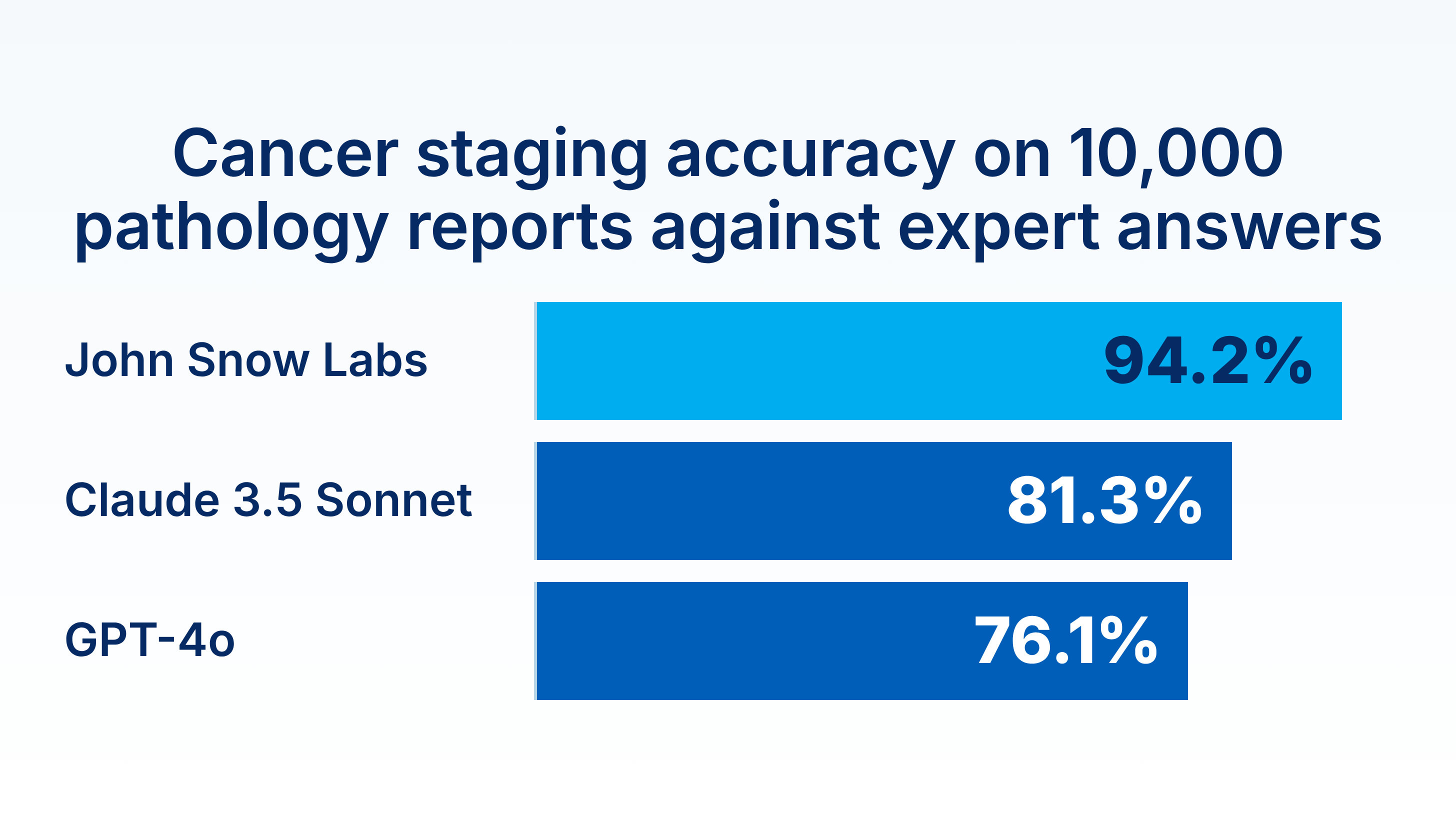
The first numbers are from cancer registries. On 10,000 pathology reports, an automated pipeline gave the same answer as certified tumor registrars, the specialists who fill cancer registries, for 98.4% of primary sites (where the cancer started), 97.6% of tumor types, and 94.2% of cancer stages. Those numbers are from John Snow Labs’ winning entry in the PHUSE US Connect 2026 RWE Catalyst Challenge, and a CDC audit of 34 cancer registries measured human abstraction at 95.0%.
The John Snow Labs team built that pipeline and helps organizations deploy it, and it already runs in production on real-world data. It’s a technological first. It’s also complex to build, and it can’t be done by dumping a patient’s full record into an LLM. Three findings from 2026 explain why:
A pipeline tuned to one registry’s fields, guidelines, and patient population is as accurate as certified registrars, in minutes per case where manual work takes two hours.
One LLM prompt over the full chart falls well short, and the accuracy comes from a system with six hard parts around the models.
Built once, that system fills each new registry from a no-code specification in 6 to 8 weeks.
Automation at 94% to 98% against 95% for human experts
In the PHUSE evaluation, the pipeline’s answers matched certified registrars’ answers 94.2% to 98.4% of the time across three fields. A blind, head-to-head evaluation against certified registrars has been completed since PHUSE, and it confirmed the result.
For the human side, the CDC’s National Program of Cancer Registries audit rechecked 13 data elements at 34 central cancer registries for diagnosis years 1998 to 2001. It found 95.0% of them correct.
Independent teams report similar results when a system is fitted to its task. At Johns Hopkins, an LLM-based tool reached 96.7% average accuracy across seven registry fields on 330 pancreatic cancer pathology reports, after tuning on 150 others (McPhaul et al., medRxiv, March 2026). Moved to 34 breast cancer reports without retuning, it lost 3 points on average and fell from 99.7% to 88.2% on one staging field.
At Cleveland Clinic, a commercial system reached 94.78% overall accuracy against registrar-abstracted data across 33 colorectal cancer registry fields, and the authors traced its weakest field to an ambiguous field definition (ASCO 2026 meeting abstract e15516).
Two other 2026 studies, Digital Registrar in Diagnostics and a Singapore cancer center pipeline on medRxiv, report scores of 92% to 97% on their own hospitals’ records.
A pipeline tuned to one registry’s fields, one set of coding guidelines, and one patient population is now as accurate as certified registrars. That is the plain meaning of regulatory-grade: as accurate as certified experts on the same task, with every value traceable to the document it came from.
That accuracy is what lets a registry be trusted for decisions about current patients. Clinicians can see what’s working, or what’s causing harm, while the plan can still change, and patients can be matched to trials and personalized treatments that depend on the exact details a registry captures.
Under two minutes per case and daily registry updates
The automated pass takes under two minutes per case in the same PHUSE evaluation, against about 120 minutes of manual abstraction, a 98% reduction. With a registrar reviewing every pre-filled case, John Snow Labs’ cancer registry documentation puts the total at 10 to 20 minutes. The cost saving follows from the time: the same team covers several times the caseload, and review goes to the ambiguous cases.
National cancer surveillance programs require complete reporting within 23 months of diagnosis, which leaves a two-year lag between diagnosis and reporting. The CDC’s faster benchmark is 90% of cases reported within 12 months, and only 14% of the registries sampled met it consistently (CDC-funded NAACCR report on registry operations, 2020). A registry that old supports surveillance and retrospective research.
A registry that updates daily as new documents arrive removes that lag, which is what makes the trial matching and treatment review described above possible. The registry supplies current, coded facts, and clinicians make the decisions.
General LLMs alone at 69% to 87% on 5,939 patients
The largest 2026 test of general purpose LLMs on registry work used 5,939 patients with seven cancer types at UNC Health (Fuchs et al., medRxiv, June 2026). Five models were given each field’s official definition, allowed codes, and coding instructions, with no worked examples.
Claude Sonnet 4.5, one of the two best performers, got 69% to 87% of answers right depending on the field, and the exact date of diagnosis 55.5% of the time. The authors conclude that fully automated abstraction “remains a challenging venture.”
Cardiology shows the same gap. On 4,214 registry answers from the American College of Cardiology’s national registry, an LLM matched the expert consensus exactly 87% of the time, while human abstractors agreed with each other about 98% of the time (Matheson et al., arXiv, August 2026). In the PHUSE evaluation, GPT-4o reached 76.1% on cancer stage and Claude 3.5 Sonnet 81.3% with a few worked examples in the prompt, against 94.2% for the tuned pipeline.
At Stanford, 100 breast cancer charts had a median of 3,100 pages each (Dickerson et al., medRxiv, September 2026), more than a general LLM can read in one pass, and the coding rules add 2,500+ pages. The PHUSE submission estimated $112.50 to run 5,000 pages through Claude Opus 4.6 once. That’s about $1.1 million for one pass over 10,000 patients, before any daily refresh.
The fields that general LLMs miss most are the ones that need a timeline, such as the exact diagnosis date at UNC and the order of treatments at Stanford. Adding retrieval or multiple agents helps on some fields and falls short on others, in studies from Sultan Qaboos University at BioNLP 2026 and of 811 myeloma patients on arXiv.
Six hard parts and 42 capabilities behind one registry
Going from 81.3% to 94.2% on cancer stage took a system around the models, and six parts of it are the hard ones to build:
Multimodal data integration: records from the EHR, scanned PDFs, pathology and radiology reports, and imaging data go into one patient record, mapped to standard codes. Small local models first remove the more than 96% of documents that aren’t relevant to the registry, so the expensive reasoning runs on what’s left.
Reasoning over duplicate, conflicting, and outdated facts: several notes describe the same biopsy, a stage found after surgery supersedes the one estimated before it, and a suspicious imaging finding turns out benign. John Snow Labs’ data integration layer resolves conflicts by source priority, then recency, then confidence, then clinical logic, and flags what it can’t resolve.
The registry filling engine: agents turn each registry’s coding guidelines into fixed decision rules for staging, tumor type, biomarkers, and treatment, so the same chart produces the same answer every time it’s processed.
Governance and audit readiness: every value keeps its source document, the text it came from, the model version, a confidence score, and a timestamp, and no patient data leaves the organization’s environment.
The review screen and workflow: registrars see each pre-filled field with supporting and contradictory evidence, low confidence fields are marked for attention, and every edit records the original value, the reviewer, and the time.
Publication: validated cases pass edit checks and completeness checks, then export as a versioned release in the registry’s own format, such as the NAACCR XML that North American cancer registries use.
A September post on fact-level provenance counted 42 capabilities in a platform like this, and estimated two to three years of engineering for a senior team new to healthcare. That scope is why building it in house, registry by registry, doesn’t work today: a cardiology registry and an oncology registry would each need the same six parts.
One shared foundation and 6 to 8 weeks per registry
All six parts are the same whichever registry is being filled. What changes from one registry to the next is the cohort and the list of fields, so those are the two things a new registry should need defined.
On John Snow Labs’ platform, a custom registry is defined with “No coding and no pipeline configuration.” The cohort is scoped with filters over a standard patient data model (OMOP), or with a template or a plain language description. Each field is then described with six properties:
Name and display name: the identifier used in exports and the label reviewers see.
Category: demographics, clinical, lab, medication, procedure, or a custom one.
Data type: free text, date, number, yes or no, or coded value.
Extraction instruction: a plain language description of what to find, in which document types, and in which terminology.
Example values: one per line, including edge cases and values that shouldn’t match.
Each published version of that specification is kept, so a past release can be traced to the definitions it used.
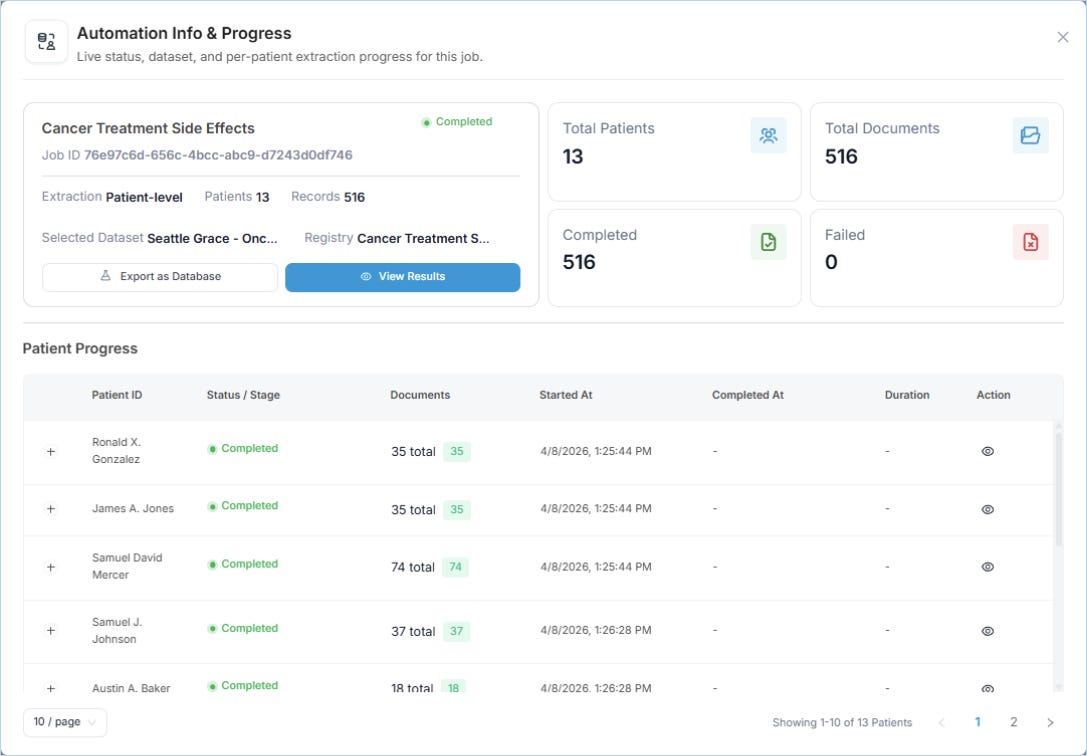
With the foundation in place, the registry documentation puts a new custom registry at 6 to 8 weeks, including a validation pilot on 100 patients. The foundation is a one-time project: a full enterprise deployment takes 8 to 12 weeks, after a pilot on 100 to 1,000 documents in the first day or two (data integration documentation). The same data then serves registries, quality measures, cohort queries, and AI agents without a new pipeline for each.
The pilot exists because a new registry needs its own validation: the Johns Hopkins drop above shows what an untuned specification scores.
Build no-code patient registries end to end
Automated registries now match certified experts’ answers 94% to 98% of the time, in minutes per case, and they stay current every day. That turns a registry from a two-year-old archive into something clinicians and researchers can act on: what’s working for patients in treatment now, who qualifies for a trial, and which safety problems are appearing.
The accuracy comes from a tuned pipeline with six hard parts, built once. Every registry after that, for a new disease or a new study, is a no-code specification and a 6 to 8 week project that reuses the work already done.
To see one built end to end, watch From Clinical Documents to Automated Patient Registries, a webinar by Mahmood Bayeshi of John Snow Labs. It covers five steps on one platform:
Case finding and document selection across structured data and notes.
Patient level reasoning that rebuilds timelines and resolves conflicting findings.
Abstraction and coding against versioned registry specifications and guidelines.
Expert validation with supporting and contradictory evidence, confidence per field, and an audit trail.
Several no-code registries configured on the same patient journeys.
If a registry in your organization is filled by hand today, the recording shows how the same registry can be filled automatically, for every patient, every day.
Frequently asked questions
What is a patient registry?
A patient registry is a standardized record of every patient with a given disease or treatment: the diagnosis, disease details such as stage and biomarkers, treatments, and outcomes. Hospitals, health agencies, and researchers use registries to track disease, measure quality of care, and find patients for studies. Most are filled by hand by certified specialists.
What does regulatory-grade accuracy mean for a patient registry?
It means automated abstraction is as accurate as certified experts on the same task, and every value can be traced to its source document. In the PHUSE evaluation that was 94.2% to 98.4% agreement with certified tumor registrars on three fields across 10,000 pathology reports, since confirmed in a blind head-to-head evaluation. A CDC audit of human abstraction found 95.0%.
Can a general LLM get the same result from the full chart?
The 2026 evidence says no. On 5,939 UNC Health patients, a leading general LLM got 69% to 87% of answers right depending on the field, and an LLM matched 87% of cardiology registry answers where human abstractors agreed about 98% of the time. Cancer charts also run to thousands of pages, more than a model can read in one pass.
Does automated abstraction replace certified registrars?
No. Registrars review the pre-filled record, confirm or correct the flagged fields, and approve the case. The documentation puts their time per case at 10 to 20 minutes, down from about two hours.
How long does it take to add a new registry?
About 6 to 8 weeks once the data foundation is in place, including a validation pilot on 100 patients. The registry itself is a cohort plus a field specification, with no code. The foundation is a one-time deployment of 8 to 12 weeks.
How often can an automated registry update?
Ingestion can run daily, and new documents are merged into each patient’s record with their provenance. National surveillance programs require complete reporting 23 months after diagnosis, so a daily registry can support work on patients who are still in treatment.
Does patient data leave the organization’s environment?
No. The pipeline runs inside the organization’s own infrastructure with no external LLM API calls. Its models are deterministic and versioned, so the same record produces the same result when it’s processed again.
The two hours per chart is the number that stuck with me. A registry running a year or two behind means clinicians are deciding with last year's patients. Minutes per patient changes who can afford to keep one at all, not just how fast.