


Originally published in MedCity News, Rama on Healthcare, and Gene Online — June 2025. Recast for this Substack with updated CMS figures, regulatory context, and a sharper framing on the accuracy and compliance requirements now facing Medicare Advantage plans.
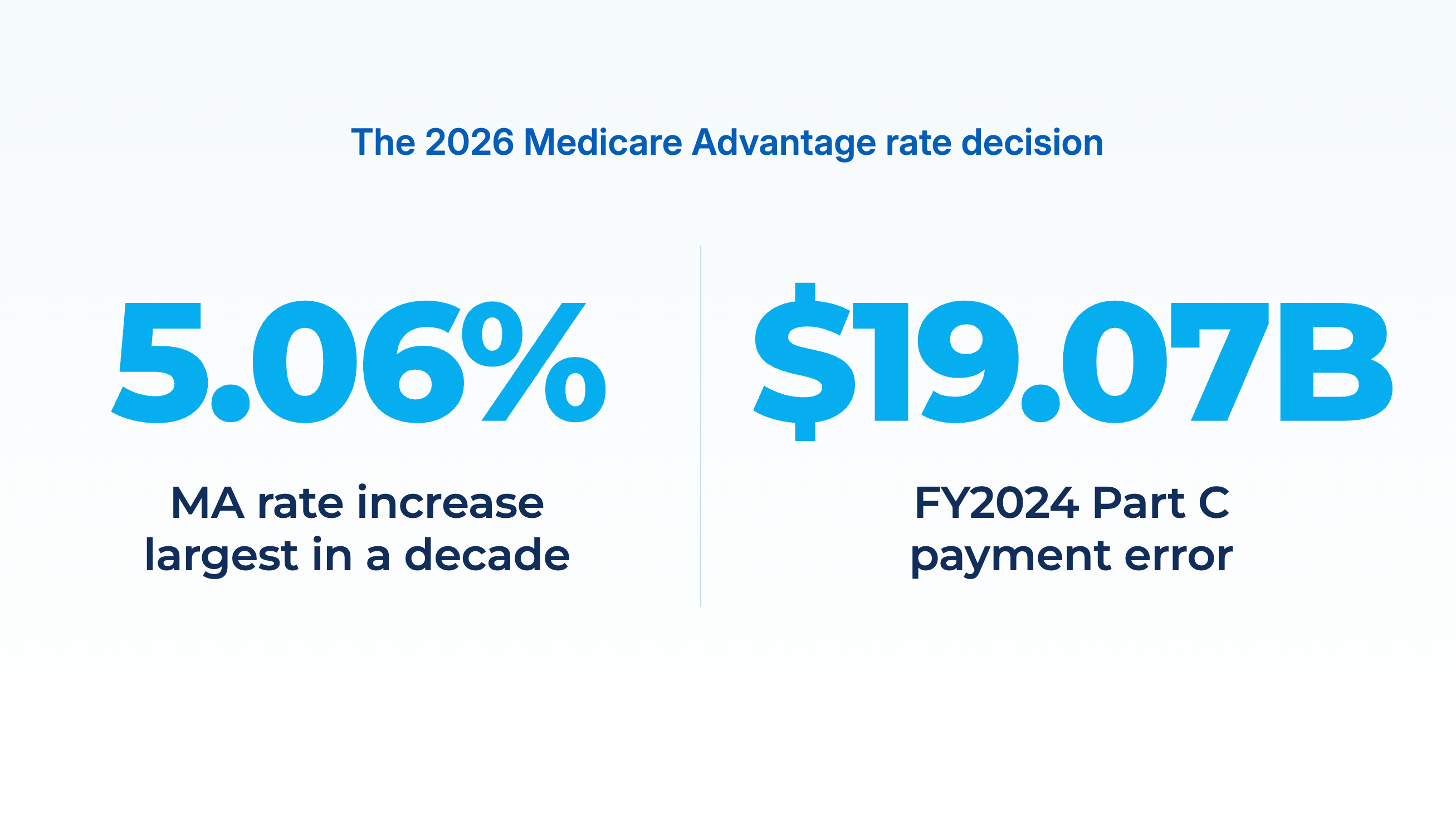
CMS announced a 5.06% average increase in payments to Medicare Advantage plans for 2026, the largest rate increase in a decade. The headline was easy: more funding per member. The implication was harder: a larger payment base creates a larger audit surface, and CMS and the Office of Inspector General have been explicit that rate increases will now be tied more tightly to coding integrity. The FY2024 Part C payment error already sits at $19.07 billion. HCC coding accuracy in 2026 is a compliance baseline, not a revenue lever.
What the 2026 MA rate announcement actually signals
The 5.06% average rate increase is notable in isolation. It is more notable in context. The 2025 rate was 3.70%. 2024 was negative on an effective basis once coding trend adjustments were factored in. The jump to 5.06% in 2026 reflects CMS confidence that the MA program can absorb higher payments without collapsing into the overpayment problem that has dogged the program for a decade. That confidence has strings attached.
CMS has been re-tuning the mechanics underneath the rate. The CMS-HCC V28 model restructured how conditions map to HCC categories, with changes to diabetes, mental health, cardiovascular, and chronic kidney disease staging. The transition from V24 to V28 is still being phased in, which means plans in 2026 will be running dual logic for at least another payment year. RADV audits are being pushed to a quarterly cadence on eligible contracts. OIG has repeatedly flagged diagnoses sourced only from health risk assessments or chart reviews without supporting documentation elsewhere in the record.
Putting that together: the 2026 payment environment is higher-dollar, higher-scrutiny, and more complex than any previous year. A plan that grew comfortable with a 2-to-3% error rate in 2023 is now operating in a regime where that error rate is visible and actionable.
The documentation gap is the accuracy problem in disguise
HCC coding is a translation problem. It starts with clinical reality (what conditions a patient actually has, documented in progress notes, specialist consults, imaging reports, and pathology) and ends with a structured submission (ICD-10 codes mapping to HCC categories, with MEAT evidence linking back to an encounter). The translation fails in two directions. Diagnoses that exist in the record and the claims go through correctly. Diagnoses that exist only in unstructured notes get dropped. Diagnoses that exist in the claims but aren’t supported in the notes survive submission and fail audit.
The scale of what gets dropped is the underreported part. Research and industry analysis indicate that as many as half of all patients may have prior conditions, complications, or severity indicators documented in clinical notes but not reflected in claims or electronic health records. The asymmetry matters. A conservative plan that only submits what is in structured claims data captures perhaps half of the eligible risk. A plan that submits from claims plus chart review captures more, but without a defensible chain from diagnosis to documentation, a meaningful share of those codes will come back in RADV. The result in either direction is financial loss: undercoding leaves risk-adjusted revenue on the table; unsupported upcoding becomes a clawback.
Undercoding also has a clinical consequence that is often framed as a revenue story but is really a patient-care story. If a patient with chronic kidney disease and heart failure has both documented in the cardiologist’s note but neither reaches the plan’s risk profile, care coordination tools, high-risk outreach programs, and population health analytics see a healthier patient than the patient actually is. Gaps in care follow. Missed interventions follow. The member appears less sick than they are on every dashboard the plan runs, and the care model treats them accordingly.
What regulators have made clear about 2026 and beyond
Three regulatory signals are worth tracking closely:
RADV cadence. CMS has signaled intent to audit all eligible MA contracts on a quarterly basis. A plan that previously got audited every several years needs to operate assuming it will be audited this quarter. That changes what “audit-ready” means. It shifts from “we could produce documentation if asked” to “every code we submit this quarter will be looked at.”
OIG’s focus on HRA-only and chart-review-only codes. The OIG has been explicit that diagnoses appearing only on health risk assessments or retrospective chart reviews, without MEAT evidence in the broader medical record, are a specific audit target. Plans that have been relying on aggressive retrospective review programs are the ones exposed.
Extrapolation. CMS can extrapolate audit findings from a sampled subset of charts to the full contract. A 5% error rate on a 200-chart sample becomes a 5% adjustment on the full contract. For a large MA plan, a 5% extrapolated adjustment is a nine-figure event.
The composite picture: in 2026, the plans that thrive are the ones that can defend every submitted code with clean documentation, on a quarterly cadence, at the scale of a full book of business. The plans that get hurt are the ones whose coding operations were built for an audit rhythm that no longer exists.
What AI-supported HCC workflows have to deliver
AI is not new to HCC coding. Rules-based and NLP-based coding assistants have been in production for a decade. What changed with generative AI is the ability to read unstructured notes at scale and to produce coding suggestions with the context and evidence required for MEAT compliance. That shift makes AI relevant in a way prior generations of automation were not. It also raises the bar for what a responsible AI-supported HCC workflow has to provide.
Four requirements, in order:
Runs in the customer’s environment. An AI coding workflow that ships protected health information to a third-party API is a HIPAA risk regardless of business associate agreements. MA plans and large provider groups need models that run on-premises or in a private cloud where no chart data crosses the firewall. That is not a deployment preference. It is a procurement gate under most healthcare security postures.
Healthcare-specific models rather than frontier general-purpose ones. A 2025 peer-reviewed study in JMIR AI, using the CLEVER methodology, found that medical doctors prefer an 8-billion-parameter healthcare-specific language model over GPT-4o 45% to 92% more often on factuality, clinical relevance, and conciseness. For HCC coding, where factuality is the entire point, that preference gap is the difference between a code that survives audit and a code that does not. Healthcare-specific language models trained on real clinical documentation read progress notes, discharge summaries, and specialist consults in a way a general-purpose model does not.
MEAT evidence tied to source. Every code the system suggests has to come with a source span: the exact text in the chart, the encounter date, the provider type, and the clinical context. That is what makes the code defensible in RADV, and that is what lets a human reviewer validate the suggestion in under a minute rather than over fifteen.
Human-in-the-loop for the codes that matter. The point of AI in HCC is not to replace certified coders. It is to raise the floor on what each coder can review. A well-designed workflow surfaces high-value, high-risk suggestions, provides the evidence to validate them, and routes them to a credentialed reviewer for final sign-off. That workflow also provides the audit trail a compliance officer needs when CMS asks why a specific HCC was assigned.
John Snow Labs’ HCC Coding Engine and the Martlet.ai platform are built to those four requirements. Models run behind the customer’s firewall, on the customer’s charts, with MEAT evidence surfaced alongside every suggestion, and with a human-in-the-loop workflow for coder review. The architecture exists because the regulatory environment now demands it. A workflow that met the 2022 bar for “AI-assisted coding” does not clear the 2026 bar for “defensible in a quarterly RADV audit.”
What MA plans and provider groups should do this quarter
Three practical moves, given where the 2026 rate announcement puts the program:
Run a gap analysis on the current book. For a random sample of 200 to 500 members, compare what is in claims against what is documented in unstructured notes. The difference is the undercoded risk (real conditions missed) and the unsupported risk (submitted codes without MEAT evidence). Both are revenue-relevant and audit-relevant; they need to be sized before the next submission cycle.
Stress-test the coding pipeline against V28. The V28 transition changes how specific conditions (diabetes with complications, CKD stages, mental health subcategories) map to HCCs. A pipeline that was calibrated for V24 will miss revenue and compliance targets under V28 even if nothing else changes.
Audit the vendor chain. If HCC coding is outsourced, verify that the vendor can produce a defensible audit trail on every code they submit. If any portion of the pipeline is AI-assisted, verify the model runs in an environment that keeps PHI inside the plan’s controls, and that the vendor can answer what model version, training data category, and evaluation methodology produced a given suggestion. Under extrapolation, a vendor’s black box becomes the plan’s liability.
Why this matters for the broader MA program
The 2026 rate increase is not a one-off. CMS has signaled that funding growth and scrutiny growth are now linked. Plans that invest in defensible, high-accuracy HCC coding operations will be in a position to absorb future rate increases without adding audit risk. Plans that treat HCC coding as a back-office function with incremental tech refresh will find that the next audit cycle reallocates a meaningful share of the rate increase out of their books. The shift is not dramatic on any single quarter. It is cumulative over several. The plans that start now are the ones that will still be running healthy MA books in 2028.
The policy direction is clear, the arithmetic is clear, and the tooling to close the accuracy gap without shipping PHI outside the plan’s environment is available. The remaining question is execution.
FAQ
What changed in the 2026 Medicare Advantage rate announcement?
CMS finalized a 5.06% average rate increase, the largest in a decade, and continued the phased transition to the CMS-HCC V28 risk model. The increase is paired with intensified scrutiny, including a push toward quarterly RADV audits on eligible contracts and continued OIG focus on unsupported diagnoses.
What is HCC coding and why does it drive MA reimbursement?
Hierarchical Condition Category coding translates clinical diagnoses into categories that CMS uses to calculate Risk Adjustment Factor scores. A member with higher clinical complexity produces a higher RAF score, which raises the monthly capitated payment the MA plan receives. Accurate HCC coding is how plans get paid appropriately for sicker members. The CMS-HCC model currently covers roughly 7,770 diagnosis codes mapping to about 115 HCC categories.
What is the V24 to V28 transition?
CMS is phasing out the V24 risk model and phasing in V28. V28 restructures several condition categories, including diabetes with complications, chronic kidney disease staging, mental health, and cardiovascular conditions. The phase-in means plans in 2026 will be running some V24 logic and some V28 logic simultaneously. Coding pipelines calibrated for V24 will drop revenue under V28 without retuning.
What is MEAT evidence and why does it matter?
MEAT stands for Monitor, Evaluate, Assess or Address, and Treat. An HCC diagnosis has to be supported by evidence in the clinical record showing one of those four actions during a qualifying encounter. MEAT is what makes a code defensible in a RADV audit. A suggested HCC that cannot be linked back to MEAT evidence is the specific failure mode OIG and CMS have been flagging.
Why is “runs on-premises” a hard requirement for AI-assisted HCC coding?
Because HCC coding operates on protected health information at full chart depth. Shipping that data to an external API creates a HIPAA and contractual exposure that most plans cannot accept, regardless of business associate agreements. On-premises or private-cloud deployment keeps PHI inside the plan’s security perimeter and simplifies the compliance story for auditors.
What’s the role of human reviewers if AI is suggesting codes?
The AI model raises the volume of charts a coder can meaningfully review and surfaces the specific evidence for each suggestion. The credentialed coder remains the decision-maker for every submitted code. That human-in-the-loop structure is what makes the workflow defensible under audit. A fully automated pipeline that submits codes without human review carries both clinical and compliance risk that no responsible MA plan should accept.
How does AI-assisted HCC coding interact with RADV?
Done well, it improves RADV defensibility by producing a clear evidence chain for every code: the source span in the chart, the encounter date, the provider, and the MEAT context. Done poorly (treating the AI as a black-box code suggester without provenance), it worsens RADV exposure because the plan cannot defend why a specific HCC was assigned. The distinction is architectural and is worth verifying in procurement.